

Get Bitculator on Android
Marketcap:
$1,934,165,806,170
Volume 24h:
$117,112,896,179
Jun 06 Liquidations:
$0
24H Long/Short:
Coming soon
Zero Knowledge DEX (zkDEX)
What does Zero Knowledge DEX (zkDEX) mean in crypto terms?
A Zero Knowledge DEX (zkDEX) is a decentralized exchange that uses zero-knowledge proofs.
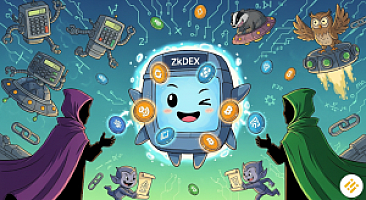
What is Zero Knowledge DEX (zkDEX)?
A Zero Knowledge DEX (zkDEX) is a decentralized exchange that confirms trades with math while keeping sensitive trade details hidden. You get the trust of on chain settlement without broadcasting your entire playbook. Think of it like a private booth at a busy market, where the cashier can verify your payment without seeing your wallet.
“A zkDEX is fully anonymous and free.” Not quite. Proofs hide trade data, but addresses can still be linkable and you still pay network fees for verification.
How Zero Knowledge DEX (zkDEX) works
Here is a quick walkthrough that keeps the math behind the curtain but the flow crystal clear.
- Start: You connect a wallet and submit a swap or order.
- Prove: The system builds a compact proof using zero-knowledge proofs that your trade is valid without exposing your exact inputs.
- Match: Your order gets matched in a batch or routed through a pool, so individual intent is harder to snoop.
- Settle: The on chain contract verifies the proof and moves your tokens if everything checks out.
- Record: The chain stores a minimal record, not your play by play.
It still feels like peer-to-peer transactions, just with less oversharing and more math doing the heavy lifting.
Why Zero Knowledge DEX (zkDEX) Matters
You care because better execution with fewer eyes on your moves is a win.
- Benefit: Stronger privacy, fewer copy trades, and often lower slippage due to batch settlement.
- Perspective: Fights spammy surveillance, reduces some MEV vectors, and brings pro grade features to regular wallets.
- Relevance: You will see these inside decentralized finance (DeFi) apps, DAO treasuries, and even wallet native swap tabs.
Zero Knowledge DEX (zkDEX) turns verification into a background process, so you trade with confidence, not a megaphone.
Check what the zkDEX hides by default. Some hide amounts, some hide addresses, some hide both. That small detail changes your strategy.
Key Characteristics of Zero Knowledge DEX (zkDEX)
Here is what gives it that private yet verified vibe:
- Verification: Proofs get checked on chain so trades are valid without exposing raw data.
- Batching: Orders settle in groups which can reduce costs and make snooping harder.
- Latency: Settlement can be quick, but proof creation and posting still take time.
- Control: You keep custody in your wallet while the contract enforces rules.
- Disclosure: Some designs offer view keys for audits or selective sharing when needed.
Variations
Not all private exchanges are built the same. Quick tour:
- AMM: Private swaps through liquidity pools with hidden trade details.
- Orderbook: Encrypted intents matched off chain then proven on chain.
- Rollup: Proofs posted to a base chain for security and data checks.
- Appchain: A dedicated chain focused on private trading and settlement.
Private trading does not erase market risk. Price impact, fake tokens, and smart contract bugs still apply on a zkDEX, so keep your normal checks in place.
Example
You swap ETH for a new token on a Zero Knowledge DEX (zkDEX), the contract verifies a proof, your wallet receives the token, and outsiders cannot see the exact amount you traded.
Fun Fact
The core idea behind modern proofs was sketched in the eighties by cryptographers who showed you could convince someone you knew a secret without revealing the secret itself, long before anyone was swapping memes for coins.
Wrap-Up
In one line: a Zero Knowledge DEX (zkDEX) lets you trade with on chain trust while keeping your moves out of the spotlight.
Explore Other Crypto Terms
Did you find this term clearly defined?
Did we forget anything?
Your input helps us keep things correct. Contact us if anything is incorrect or missing.
Contact