

Get Bitculator on Android
Marketcap:
$1,938,367,710,878
Volume 24h:
$133,188,238,232
Jun 06 Liquidations:
$0
24H Long/Short:
Coming soon
Zero Knowledge Application (zkApp)
What does Zero Knowledge Application (zkApp) mean in crypto terms?
A Zero Knowledge Application (zkApp) is a decentralized application that use zero knowledge proofs to enhance privacy and security.
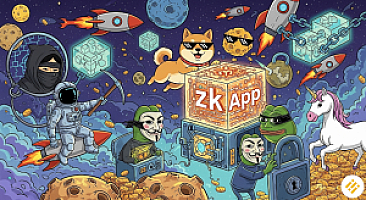
What is Zero Knowledge Application (zkApp)?
A Zero Knowledge Application (zkApp) is a blockchain program that proves it followed the rules without revealing the private data it used. Think bouncer vibes: you prove you are old enough, but your birthday stays your business. The chain verifies math, not secrets.
“A Zero Knowledge Application (zkApp) makes everything anonymous.” Not quite. It can hide inputs while keeping outcomes verifiable, but many zkApps still show what matters for consensus and fees.
How zkApps work
Picture this: a Zero Knowledge Application (zkApp) proves you meet a rule set without exposing your data. It relies on zero knowledge proofs to make that verifiable to everyone.
- Step 1: You open the app and choose what you want to prove, like income above a threshold or ownership of a token.
- Step 2: Your device creates a proof that the statement is true, using a circuit the app provides. No raw data leaves your device.
- Step 3: The proof plus minimal metadata gets wrapped into a transaction and sent to the network.
- Step 4: The smart contract checks the proof with a verifier. If it passes, the contract proceeds.
- Step 5: The chain updates state, like granting access, moving funds, or recording a vote, without revealing your private inputs.
Yep, that’s it. Math does the talking so your data doesn’t have to.
Why zkApps Matter
So what’s in it for you?
- Benefit: Real privacy with public verification, meaning fewer leaks and fewer hoops.
- Perspective: They fit the moment where people want control of data and proof of authenticity, Rolex meets Reddit threads.
- Relevance: Expect them in DeFi credit checks, private voting, KYC light access, gaming, and even creator memberships.
Before using a Zero Knowledge Application (zkApp), check whether proofs are generated locally and how long it takes on your device. If the app offers a proof service, make sure you still control what data gets shared.
Key Characteristics of zkApps
What sets them apart:
- Proofs: They show correctness of a computation without exposing the inputs.
- Minimal: Only necessary data lands on chain, which is good for fees and privacy.
- Composability: Proof verified in one app can unlock actions in another.
- Local: Heavy work can happen off chain on your device, then the chain just verifies.
- Auditable: The math is public, so anyone can verify the result independently.
Variations
Not every build is the same. Common flavors you’ll see:
- SNARK: zkApps based on succinct proofs that verify fast and stay small.
- STARK: Proofs without trusted setup, often larger but transparent and scalable.
- Rollup: Apps inside zk rollups that batch many actions with a single proof.
- Identity: Proof of personhood, age, residency, or membership without doxxing.
- DeFi: Private swaps, credit checks, and collateral checks with selective disclosure.
Zero knowledge protects inputs, not logic. Bad economics or buggy contracts can still lead to exploits, so audits and limits still matter.
Example
You use a Zero Knowledge Application (zkApp) to prove your account holds a threshold of tokens to join a private Discord, while your exact balance stays hidden.
Fun Fact
The math behind zk proofs traces back to the 1980s, but the catchy zkApp label only took off once builders started packaging those proofs into everyday blockchain apps you can actually click.
Wrap-Up
In one line: a Zero Knowledge Application (zkApp) lets you prove things on chain without oversharing, which feels like the internet growing up a little.
Explore Other Crypto Terms
Did you find this term clearly defined?
Did we forget anything?
Your input helps us keep things correct. Contact us if anything is incorrect or missing.
Contact