


Get Bitculator on Android
Marketcap:
$1,932,902,784,075
Volume 24h:
$209,175,082,222
Jun 06 Liquidations:
$0
24H Long/Short:
Coming soon
Risk Assessment
What does Risk Assessment mean in crypto terms?
Risk assessment is the process of evaluating potential risks associated with an investment or trading strategy.
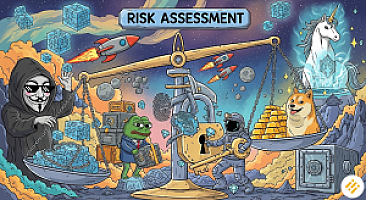
What is Risk Assessment?
Risk Assessment is the practice of spotting what could go wrong with a crypto asset, protocol, or trade, judging how likely it is, and estimating the damage if it happens. Then you decide what to do about it. Think of it like checking the weather before a road trip so you know if you need sunglasses or a raincoat.
“Risk Assessment kills upside.” Not true. It helps you size bets, set stops, and avoid blowups so you can actually stay in the game long enough to catch winners.
How Risk Assessment works
Here’s a quick walk through with a new yield farm that promises 250 percent APY. Tempting, right? Breathe first.
- Scope: Define what you’re judging. The farm, its token, your position size, and the time frame.
- Data: Pull facts. Code audits, team history, liquidity depth, and whether the platform runs proper anti-money laundering (AML) checks.
- Risks: List them. Smart contract bugs, rug pulls, price crashes, oracle errors, fee spikes.
- Score: For each risk, estimate probability and impact. High chance small loss is different from tiny chance total wipe.
- Move: Choose actions. Maybe you cap size, set alerts, split entries, or skip entirely. Yep, sometimes the best trade is no trade.
Then you monitor and update as new info comes in. Simple, not easy.
Why Risk Assessment Matters
Because vibes are not a strategy. Here’s what you get when you actually do it:
- Benefit: Fewer nasty surprises and fewer sleepless nights. You still chase upside, just with a plan.
- Perspective: Your view should shift with market conditions. Bull euphoria and bear fear both mess with judgment.
- Relevance: You’ll see it everywhere in crypto trading, staking, NFTs, DeFi pools, and DAOs voting on proposals.
Write every risk as “If X happens, I lose Y because Z.” It forces clarity and makes Risk Assessment actionable, not theoretical.
Key Characteristics of Risk Assessment
What makes it click:
- Probabilities: It weighs likelihood instead of guessing vibes.
- Impact: It measures how bad a hit could be, from annoyance to portfolio ender.
- Holistic: It looks across tech risk, liquidity risk, counterparty risk, and compliance like know-your-customer (KYC).
- Iterative: It updates as prices move and new info drops.
- Practical: It ends in action you can actually take, like position sizing or setting alerts.
How is Risk Assessment calculated?
There isn’t one magic formula, but a common lens is expected loss using probability and impact.
The expected loss can be estimated by multiplying the probability of an event by its potential impact:
Expected Loss = Probability of Event × Impact if Event Happens Example: If there’s a 20 percent chance a token drops 30 percent on a bad update, the expected loss on a 1000 position is:
Expected Loss = 0.20 × 300 = 60 You can stack multiple risks by summing their expected losses, while remembering that real life rarely behaves like a tidy spreadsheet.
Variations
Main flavors you’ll run into:
- Qualitative: Judgment calls based on team, roadmap, community, narrative.
- Quantitative: Numbers driven with stats, volatility, drawdowns, and models.
- Protocol: Consensus design, validator incentives, upgrade process.
- Smart: Contract bugs, audits, admin keys, oracle design.
- Counterparty: CeFi custody, exchange solvency, lending desk exposure.
- Regulatory: Jurisdiction, policy shifts, enforcement headlines.
- Liquidity: Slippage, spreads, depth, withdrawal limits.
No model can see every black swan. Position sizing is part of Risk Assessment too, and yes, cash can be a position.
Example
You’re considering a new NFT mint, you set a max spend, check contract permissions, watch secondary bids, and only mint if the plan still fits your Risk Assessment.
Fun Fact
Early Bitcoin traders used forum threads as Risk Assessment reports, crowdsourcing red flags before audits were trendy. Call it Reddit meets Rolex energy.
Wrap-Up
Think of Risk Assessment as the compass that keeps you focused on the balance between risks and rewards while everyone else chases shiny objects.
Explore Other Crypto Terms
Did you find this term clearly defined?
Did we forget anything?
Your input helps us keep things correct. Contact us if anything is incorrect or missing.
Contact