


Get Bitculator on Android
Marketcap:
$1,941,200,010,488
Volume 24h:
$171,051,707,417
Jun 06 Liquidations:
$0
24H Long/Short:
Coming soon
Internet of Things (IoT)
What does Internet of Things (IoT) mean in crypto terms?
Internet of Things (IoT) refers to a network of interconnected physical devices equipped with sensors, software, and other technologies that lets them collect and exchange data.
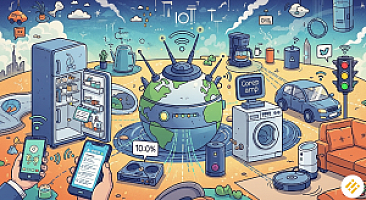
What is Internet of Things (IoT)?
The Internet of Things (IoT) is the idea that everyday objects can sense, share, and act on data through the internet. Think thermostats, cars, fridges, and factory robots chatting with apps and each other. Picture your devices forming a group chat and actually doing chores while you sip coffee.
IoT is just smart home toys. Not even close. It also runs factories, tracks pallets, manages energy grids, and can settle tiny crypto payments without you lifting a finger.
How Internet of Things (IoT) works
Quick tour that skips the fluff. The Internet of Things (IoT) starts with a sensor, ends with an action, and often sneaks in a payment or a log.
- Trigger: A sensor reads something like temperature, location, or motion.
- Talk: The device sends that reading to a nearby hub or straight to the cloud, like a fridge reporting its internal temp.
- Think: Software checks rules you set, then decides what should happen.
- Act: It flips a switch, pings you, or pays another device for a service.
- Settle: Devices can transact in a machine-to-machine way, for example a car paying a charger per minute.
That is the idea. Quiet teamwork between gadgets that saves you time.
Why Internet of Things (IoT) Matters
Why should you care? Because it saves time, trims costs, and creates new ways to earn and spend, sometimes without a human in the loop.
- Benefit: Automation that lowers bills and reduces guesswork, from energy use to fleet routing.
- Perspective: Billions of devices push serious Scalability demands, which is why crypto style networks and rollups get attention here.
- Relevance: You will see it in supply chains, pay per use devices, and dApps that reward sensors for verified data.
When testing IoT ideas, start local with edge processing and a tiny rules engine. If it works offline, it will feel great when you sync it later.
Key Characteristics of Internet of Things (IoT)
What makes it special is not just sensors, but how the system behaves as a whole.
- Connectivity: Devices chat over Wi Fi, cellular, or mesh and pass messages to apps.
- Sensing: They measure the real world, from heat to vibration, then turn it into data.
- Automation: Rules turn data into actions without waiting for you.
- Security: Identity, encrypted traffic, and signed updates keep bad actors out.
- Compatibility: Real gains come when systems talk across brands, which is why Interoperability matters.
- Economy: Tiny payments and rewards enable new business models for sensors and services.
Variations
The Internet of Things (IoT) shows up in a few flavors, each with its own vibe:
- Consumer: Smart lights, thermostats, wearables, and pet feeders that text you back.
- Industrial: Factories and logistics with predictive maintenance and asset tracking.
- Automotive: Cars that pay for charging, tolls, and parking on their own.
- SmartCity: Meters, traffic lights, and sensors that cut waste and wait times.
- Edge: Local compute that reacts fast and keeps sensitive data close.
The Internet of Things (IoT) multiplies convenience and also attack surfaces. Change default passwords, keep firmware current, and separate your networks like you would separate your savings from your spending cash.
Example
A solar roof sells spare power to a neighbor, meters the flow with a sensor, then settles a tiny token payment in seconds.
Fun Fact
Kevin Ashton pitched the phrase Internet of Things in 1999 while thinking about linking barcodes and sensors to the internet, not smart speakers or robot vacuums.
Wrap-Up
Short take: the Internet of Things (IoT) is devices that notice, decide, and do, sometimes even paying each other while you sleep.
Explore Other Crypto Terms
Did you find this term clearly defined?
Did we forget anything?
Your input helps us keep things correct. Contact us if anything is incorrect or missing.
Contact